
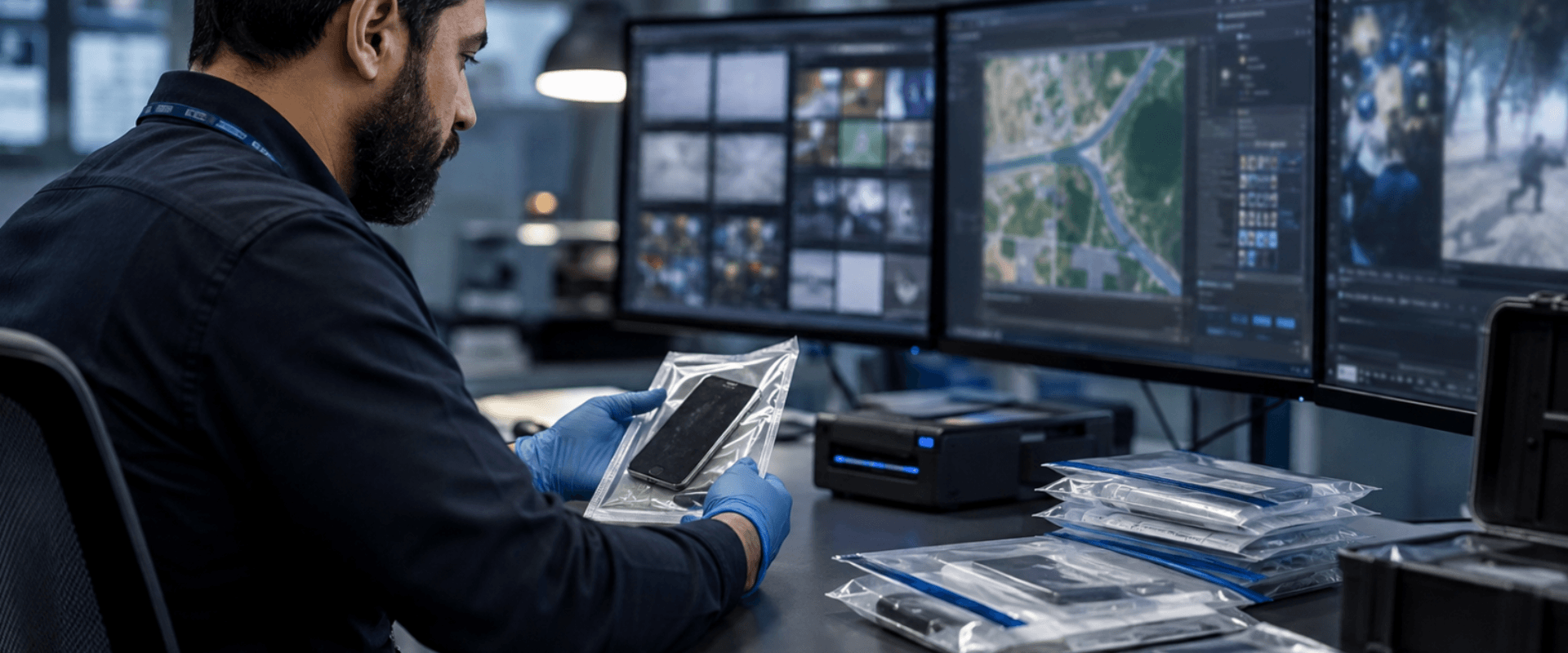
Digital evidence is now central to almost every area of modern policing.
It may originate from a mobile device, CCTV system, cloud service, vehicle, body-worn camera, social platform, specialist sensor or one of many other sources. It may be acquired by a frontline officer, investigator, digital forensic practitioner or specialist unit. It may then pass through several systems before it is reviewed, shared, disclosed, retained, archived or eventually disposed of.
Each individual technology in that chain may work perfectly well.
And yet the overall evidence journey can still be slow, duplicated, expensive, difficult to govern and frustrating for the people who rely on it.
That is because digital evidence is not simply a digital forensics problem.
It is an end-to-end information, technology and operational lifecycle.
The unit of design therefore needs to be the evidence journey, not the individual product, departmental boundary or procurement exercise.
Digital evidence extends far beyond the DFU
Digital Forensic Units remain a critical part of the policing ecosystem. They provide specialist examination, technical expertise, quality controls and escalation for complex cases.
But the digital evidence lifecycle extends far beyond the walls of the DFU.
Evidence may first be encountered by an officer on the street. It may be collected using a kiosk or distributed acquisition capability. Large datasets may need to be transferred across force networks. Specialist processing may take place centrally. Investigators may review material through another platform. Evidence may then need to be shared with prosecutors, disclosed to defence teams, retained for a defined period and ultimately deleted.
Each of those activities creates requirements around:
- identity and access;
- security;
- evidential integrity;
- audit;
- performance;
- data movement;
- storage;
- retention;
- resilience;
- integration;
- support;
- governance.
This is why treating digital evidence as a series of isolated technology projects creates problems.
A force can improve acquisition and inadvertently increase pressure on its network.
It can deploy cloud review and make investigator access easier while creating new questions around retention and duplicate copies.
It can add storage capacity without addressing the underlying reasons information is being retained indefinitely.
It can introduce another specialist tool that solves a particular operational problem but creates another disconnected repository.
The individual project can succeed while the wider lifecycle becomes more complicated.
Think in terms of a lifecycle
A useful starting point is to map digital evidence across the complete journey.
A simplified model might look like this:
Identify → Acquire → Transfer → Process → Review → Share → Retain → Dispose
The precise stages will vary by force, evidence type and investigation, but the principle remains the same.
Every stage should have a clear purpose, owner, set of controls and relationship with the stages before and after it.
Identification and acquisition
The first question is how digital material enters the policing environment.
This could involve:
- specialist forensic acquisition;
- distributed kiosks;
- digital evidence management platforms;
- officer-led capture;
- third-party submissions;
- cloud downloads;
- CCTV;
- body-worn video;
- external agency transfers.
The challenge is not simply whether evidence can be acquired.
The wider questions include:
- Who is authorised to acquire it?
- Where does the material go next?
- How is it uniquely identified?
- What metadata is captured?
- What happens if acquisition fails?
- How is integrity demonstrated?
- When does responsibility transfer from one team or system to another?
Those questions are lifecycle questions, not just product questions.
Transfer and movement
Digital evidence is becoming larger, richer and more distributed.
High-resolution video, mobile-device extractions and cloud datasets can place significant demands on force infrastructure.
Connectivity therefore becomes part of the evidential architecture.
A distributed acquisition model may appear operationally attractive, but it only works sustainably if evidence can move reliably from the point of acquisition to the next stage of the process.
Forces need to consider:
- bandwidth;
- latency;
- resilience;
- upload windows;
- secure transfer;
- network contention;
- local staging;
- direct-to-cloud patterns;
- central routing;
- failure handling.
A kiosk may be installed successfully while the service it supports remains constrained by the network behind it.
That is why connectivity should be designed as part of the evidence workflow rather than treated as a background dependency.
The real problems often exist between systems
Many police technology environments are made up of capable products that were procured at different times to solve different problems.
The friction tends to appear at the hand-offs.
Examples might include:
- evidence copied manually between platforms;
- temporary staging areas becoming semi-permanent repositories;
- investigators receiving material outside the intended review workflow;
- repeated downloads of the same material;
- storage growth caused by multiple derivative copies;
- retention controls applied differently in different systems;
- case closure in one platform not triggering action elsewhere;
- audit trails fragmented across multiple products.
None of these necessarily indicate that a particular system is deficient.
The problem is often that the end-to-end lifecycle was never designed as one connected capability.
This is also where organisational boundaries become important.
Digital forensics, investigations, ICT, information management, security, records management, commercial teams and technology suppliers may all have legitimate responsibilities.
But unless those responsibilities are joined together, gaps can emerge between them.
The aim should not be to remove those boundaries entirely. Specialist expertise and accountability remain important.
The aim is to design the interfaces between them deliberately.
Which copy is authoritative?
One of the most important questions in any digital evidence architecture is deceptively simple:
Where is the authoritative evidential record?
Modern workflows may create several legitimate versions of the same evidence.
For example:
- the original acquired data;
- a working forensic copy;
- processed output;
- an investigator review copy;
- a disclosure package;
- an archived version.
Not every copy is inherently unnecessary.
Different stages of an investigation may require different representations of the same material.
The problem arises when their purpose and status are unclear.
If the same evidence exists in four platforms:
- which copy governs retention?
- which copy is relied upon if integrity is challenged?
- which systems can delete their copies independently?
- which copy must remain accessible after case closure?
- which audit trail represents the complete history?
- which platform is responsible for restoring access if another system is retired?
These are architectural and governance decisions.
They should not be left to emerge organically from individual implementations.
A force therefore needs to distinguish clearly between:
- the authoritative evidential record;
- processing or working copies;
- review copies;
- derived artefacts;
- disclosure packages;
- archival records.
The organisation can then define the rules associated with each.
Evidence review as a service changes the lifecycle
What is often described as “cloud review” is, more accurately, SaaS-based evidence review.
The distinction matters.
The important change is not simply that evidence is being reviewed “in the cloud”. It is that the review capability is being delivered as a service, typically outside the force’s traditional infrastructure boundary, with different implications for identity, access, integration, support, data movement, retention and service exit.
The immediate attraction is clear.
Investigators can potentially access and review digital evidence more efficiently without relying on specialist workstations, local infrastructure or physical media.
But introducing a SaaS review platform changes several other parts of the evidence lifecycle.
Evidence needs to reach the platform.
Users need appropriate identities and permissions.
Material may need to be restricted according to sensitivity, case type or role.
Data may be duplicated between source systems, processing environments and the review service.
Audit trails need to remain complete and meaningful.
Retention must still be enforced.
Case closure needs to trigger the correct lifecycle actions.
The force also needs to understand what happens when the platform changes, the contract ends or the service is exited.
The architectural question is therefore not simply:
Which review platform should we buy?
It should be:
How should a SaaS review capability fit into our target digital evidence lifecycle?
That means understanding how evidence enters the service, how users access it, what copies are created, which record remains authoritative, how activity is audited, how retention is applied and what happens to the data throughout and beyond the life of the case.
That creates a very different conversation.
It moves the focus away from product selection alone and towards the design of the complete evidence journey.
Retention and disposal should not be afterthoughts
Storage pressure is often treated as an infrastructure problem.
Sometimes it is.
But in digital evidence environments, continued growth can also indicate lifecycle problems.
Evidence may be retained because:
- ownership is unclear;
- retention triggers are not connected to case outcomes;
- disposal decisions are difficult to execute;
- different systems hold independent copies;
- users fear deleting material that might later be required;
- data classification is inconsistent;
- older platforms lack effective lifecycle controls.
Buying additional storage can provide useful breathing room.
It does not necessarily solve the underlying issue.
Retention and disposal need to be considered at the point the lifecycle is designed, not several years later when capacity becomes constrained.
For each category of evidence, forces should be able to explain:
- why it is being retained;
- who owns the decision;
- how long it should remain;
- what event changes its retention status;
- which copies are affected;
- how disposal is authorised;
- how deletion is evidenced.
A mature lifecycle should make those decisions increasingly systematic rather than relying on large-scale retrospective clean-up exercises.
Integration is more than an API
Integration is another area where the discussion can become overly technical.
APIs matter.
But integration within an evidence lifecycle is broader than system-to-system connectivity.
It also includes:
- common identifiers;
- case and evidence metadata;
- lifecycle events;
- retention triggers;
- identity;
- permissions;
- audit;
- workflow state;
- error handling;
- ownership.
Two products may technically exchange data while still operating as disconnected services.
For example, transferring a file successfully does not necessarily answer:
- whether the receiving platform knows its evidential status;
- whether case closure is synchronised;
- whether deletion in one system should trigger deletion elsewhere;
- whether an investigator has the right level of access;
- whether a complete audit history can be reconstructed.
The integration architecture therefore needs to reflect the operational lifecycle, not simply the available product interfaces.
AI makes lifecycle design more important, not less
Artificial intelligence is likely to play an increasing role in digital evidence.
Potential uses include:
- triage;
- classification;
- transcription;
- summarisation;
- search;
- pattern detection;
- disclosure support;
- prioritisation;
- investigator assistance.
These capabilities could materially reduce the burden associated with large evidence volumes.
But AI does not remove the need for good lifecycle architecture.
It increases it.
An AI service needs to know:
- what information it is permitted to access;
- which copy of the evidence is appropriate;
- what metadata is available;
- whether its output becomes part of the evidential record;
- how its conclusions are audited;
- how long derived material should be retained;
- how human decisions are recorded;
- how access is controlled.
If the underlying evidence environment is fragmented, AI risks adding another processing layer and another set of derived outputs to an already complicated estate.
Used within a well-designed lifecycle, however, AI can become a powerful capability within the workflow rather than another disconnected tool.
Designing digital evidence as a connected capability
Forces do not need to replace every existing product to improve the digital evidence lifecycle.
In many cases, the starting point is simply to understand the current journey.
A practical approach is to work through five questions.
1. What is the complete evidence journey?
Map the lifecycle from first identification through to final disposal.
Do not stop at organisational boundaries.
Include the DFU, investigators, ICT, information management and external sharing where appropriate.
2. Who owns each stage and each transition?
Every major lifecycle stage should have clear operational and technical ownership.
The hand-offs are particularly important.
3. Which records and copies are authoritative?
Define the purpose and status of original, working, review, disclosure and archived copies.
Do not allow this to be determined implicitly by whichever platform currently stores them.
4. How should movement, access, audit and retention work together?
These should be designed as a single control model.
Optimising them independently can create unintended consequences elsewhere.
5. How does each technology fit the target lifecycle?
Products should be assessed against the required architecture rather than allowing the available product capabilities to define the architecture.
This is especially important as forces adopt more cloud services, distributed acquisition, automation and AI.
From products to outcomes
Digital evidence technology will continue to evolve.
Acquisition will become more distributed.
Evidence volumes will continue to increase.
SaaS-based evidence review will become more common.
AI will increasingly support investigators and forensic practitioners.
New specialist tools will continue to emerge.
The challenge for policing is therefore not simply selecting the right products.
It is making those products work together as part of a sustainable operational capability.
That requires an end-to-end view of evidence from the moment it enters the policing environment to the moment it can legitimately be disposed of.
The most important design question is no longer:
What should this individual system do?
It is:
What needs to happen to this evidence next – and how do we make that transition controlled, efficient and defensible?
Digital evidence is a lifecycle.
Designing it that way is increasingly fundamental to reducing duplication, controlling cost, improving investigator access and building the foundations for the next generation of policing technology.
Clarity starts with a conversation
At dstilld technologies, we work with police forces, technology partners and specialist vendors to connect operational requirements, architecture, commercial strategy and delivery assurance.
If you are facing a similar challenge, feel free to get in touch.
We are always happy to have an initial conversation, share our perspective and help you think through the problem. There is no obligation to turn that conversation into a paid engagement.
Sometimes a short discussion is all that is needed to identify the next sensible step.