
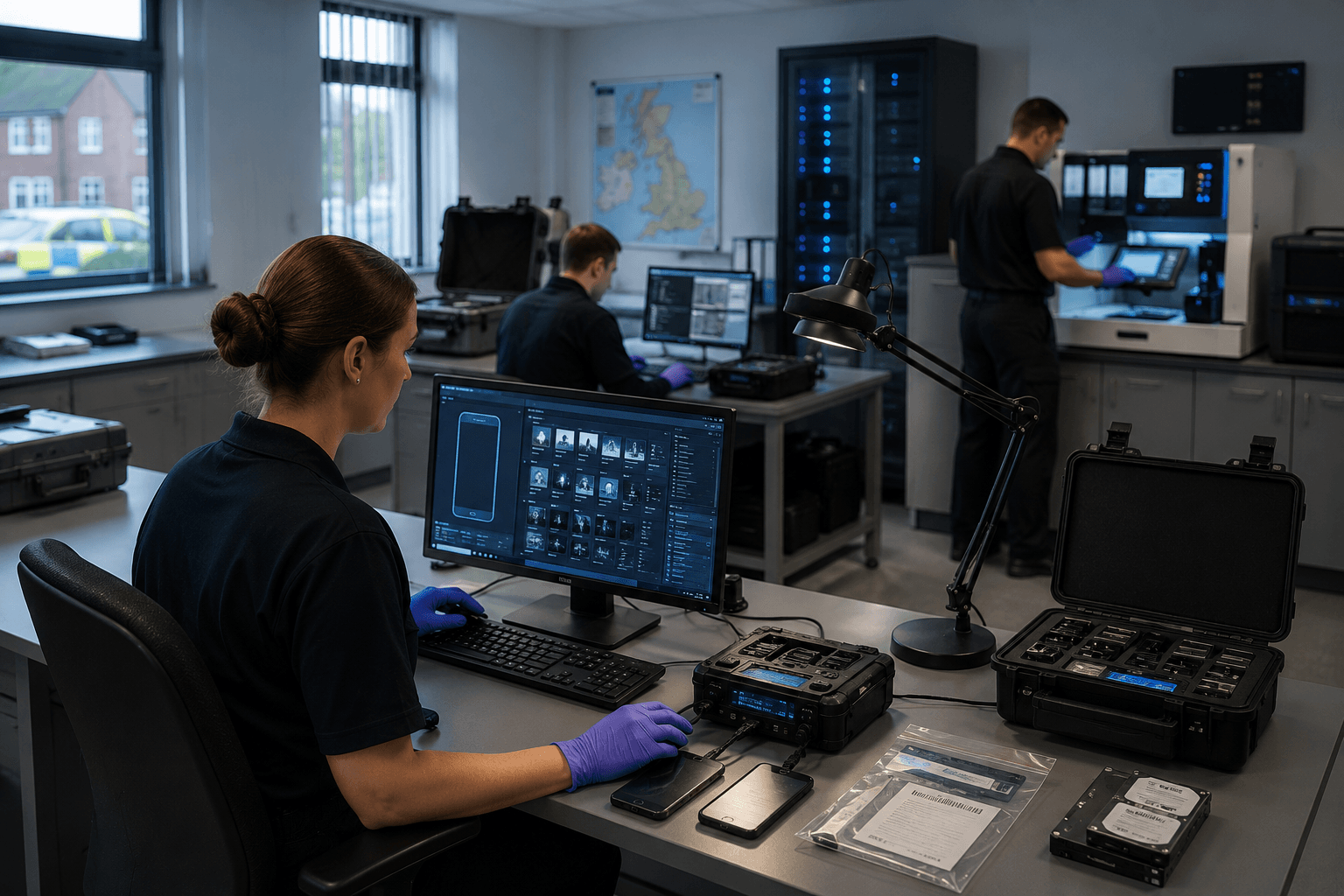
Designing the Capability, Not Just the Locations
For many police forces, the traditional model for digital forensics is under increasing pressure.
Demand continues to grow. Digital evidence is present in an ever-wider range of investigations. Specialist Digital Forensics Units remain constrained by skills, capacity and physical resources. At the same time, investigators increasingly expect faster access to evidence and greater ability to undertake appropriate activity closer to the point of need.
It is therefore understandable that more distributed models are being considered.
The language varies: hubs and spokes, satellite laboratories, remote acquisition points, kiosks, mini-labs or local digital forensic capabilities.
But the terminology can create a false sense of simplicity.
Putting forensic technology into additional locations does not, by itself, create a hub-and-spoke operating model.
A genuine hub-and-spoke capability requires clarity about what each location does, who performs the work, what happens to the data, where specialist responsibility sits, how exceptions are handled and how the overall service remains governed and assured.
The distinction matters.
If forces begin with locations and products rather than the service they are trying to create, they risk distributing technology without genuinely distributing capability.
Why hub-and-spoke models are attractive
The rationale is compelling.
A well-designed distributed model has the potential to:
bring appropriate digital forensic capability closer to investigators;
reduce unnecessary movement of devices and people;
provide quicker access to lower-complexity acquisitions;
protect specialist DFU capacity for work that genuinely requires specialist expertise;
improve resilience across a geographically distributed force;
create more consistent routes into cloud-based review and analysis;
and reduce bottlenecks created by routing too much activity through a single central location.
None of these outcomes requires every spoke to become a miniature Digital Forensics Unit.
In fact, trying to recreate the DFU everywhere would probably make the model less sustainable.
The objective should be to decide which activities can safely and effectively be distributed, and which capabilities should remain centralised.
That requires an operating model before it requires a shopping list.
A kiosk location is not necessarily a spoke
This is an important distinction.
A force may already have self-service kiosks distributed across its estate. Officers can attend a location, connect a device and perform an approved extraction.
That can be valuable, but it does not automatically make the location a digital forensics spoke.
A genuine spoke may require some combination of:
trained or specialist personnel;
defined services and eligibility criteria;
controlled workflows;
appropriate physical facilities;
acquisition and examination tooling;
secure connectivity;
local staging or processing capacity;
access to remote or cloud review platforms;
escalation routes into the central DFU;
quality management;
auditability;
and clearly assigned service ownership.
That is materially different from simply placing another forensic workstation or kiosk at a police station.
The question should therefore not be:
Where should we put the kiosks?
It should be:
What service should an investigator be able to access locally, and what capability is required to deliver it safely and consistently?
Location follows from that decision.
Start with the service catalogue
Before deciding how many hubs or spokes are required, define what each level of the model is expected to provide.
For example, a local acquisition point might support a tightly controlled set of routine activities undertaken by appropriately trained officers.
A specialist spoke might provide a broader service, with experienced digital forensic practitioners carrying out acquisitions, triage and defined examination activity.
The central DFU might retain responsibility for more complex examination, specialist techniques, damaged devices, escalation, quality management and overall professional leadership.
The precise division will differ between forces.
What matters is that it is intentional.
Each part of the model should have a defined service catalogue:
- What work can be accepted?
- Who is authorised to perform it?
- Which tools and techniques can be used?
- What falls outside scope?
- When must work be escalated?
- Where is the resulting data stored?
- How is it made available for investigation and review?
- Who owns quality and technical assurance?
Without that definition, local capabilities tend to evolve organically. Different locations begin doing different things, local practices emerge and the distinction between trained users and specialist practitioners becomes blurred.
The result can be greater capacity, but also greater inconsistency.
Design around demand, not geography alone
There is an understandable temptation to make hub-and-spoke design geographically symmetrical.
Five policing areas might suggest five spokes. A group of major stations may look like obvious locations. Existing kiosk locations can appear to provide the starting blueprint.
But geography is only one variable.
The design should also consider:
current and forecast digital forensic demand;
the type and complexity of that demand;
travel patterns and custody locations;
specialist staff availability;
investigator demand;
operational hours;
resilience requirements;
network capacity;
physical suitability;
and the relationship with neighbouring locations.
One spoke may need several specialist practitioners and significant processing capability.
Another area may only justify a controlled self-service capability.
A third may have limited local demand but be strategically important for resilience.
A distributed model should therefore be demand-led rather than simply map-led.
That also provides a much stronger basis for the business case. Investment can be linked to demonstrable operational demand and service improvement rather than an arbitrary number of locations.
Skills determine capability
Technology can be distributed relatively quickly.
Expertise cannot.
Digital forensics relies on competence, judgement and professional accountability as much as it relies on tooling.
This is particularly important when deciding which activities move away from the central DFU.
A sustainable operating model should distinguish between work that can appropriately be undertaken through controlled self-service, work that requires trained users and work that requires specialist digital forensic practitioners.
It should also recognise that competence is not static.
Users need training, maintenance of skills, procedural guidance and routes to support when something does not behave as expected.
Specialists working away from the central DFU still need access to peer support, technical escalation and consistent quality processes.
A distributed model should therefore distribute capability without fragmenting professional practice.
The central DFU may become even more important in this model – not necessarily as the place where every device is processed, but as the centre of expertise, governance, escalation and quality.
The architecture has to follow the evidence
Once work is distributed, the technical architecture becomes critical.
Extracting data at a spoke is only the beginning.
The evidence still needs somewhere to go.
A force needs to understand the end-to-end journey:
Device → acquisition → staging → processing → storage → review → investigation → retention or disposal
At each point there are architectural questions.
- How much data will be generated locally?
- Does it need to cross the WAN immediately?
- Is local staging required?
- What happens if connectivity is unavailable?
- Where is the authoritative copy?
- Does the investigator review locally, through VDI or through a cloud service?
- How is information transferred into the wider investigative workflow?
- How many additional copies are created?
- How are retention and deletion decisions applied?
- What audit information is maintained throughout?
These questions become particularly significant when large extractions or high-volume media are involved.
A technically capable forensic workstation at a remote location is of limited value if its output cannot be moved, processed or reviewed efficiently.
Connectivity and storage therefore need to be assessed before deployment, not discovered as constraints afterwards.
Cloud review changes the shape of the model
Cloud-based review has the potential to change how distributed digital forensics operates.
Historically, proximity to forensic infrastructure often dictated where evidence could be processed and reviewed.
That relationship is becoming less rigid.
A device might be acquired at one location, processed elsewhere and made available through a secure review service to investigators across the force.
That creates opportunities to separate:
where the physical device is;
where acquisition takes place;
where processing occurs;
where the evidence is stored;
and where the investigator reviews it.
Done well, this can support a much more flexible operating model.
But cloud review should not simply be bolted onto an existing process.
The force still needs to understand data movement, integration, identity, access control, evidential integrity, retention, cost and the relationship with existing on-premises storage.
A distributed operating model and cloud review strategy should therefore be designed together.
Avoid creating multiple islands of forensic infrastructure
One of the risks of decentralisation is that each spoke becomes its own technology island.
- Separate processing.
- Separate storage.
- Separate procedures.
- Separate local workarounds.
That may initially look resilient, but over time it can create unnecessary complexity and cost.
Wherever possible, the architecture should allow distributed users to consume shared services.
That could include common identity, central policy, shared storage tiers, cloud review, standard workflows, common monitoring and centralised audit.
The physical capability may be distributed.
The underlying architecture does not need to be.
This is where a hub-and-spoke model can become more than a property strategy. It can provide a pathway towards a genuinely shared digital forensics platform across the force.
Governance must remain end-to-end
Distribution can also blur ownership.
- Who owns the equipment at a spoke?
- Who is responsible for maintaining software and licences?
- Who monitors utilisation?
- Who decides which workflows are permitted?
- Who provides first-line support?
- Who owns forensic quality?
- Who is accountable when a local process fails?
These questions need explicit answers.
Operational ownership, technical ownership and professional forensic responsibility may sit in different teams, but they need to connect through one governance model.
The service should also be measurable.
A force should be able to understand demand by location, utilisation, turnaround time, escalation rates, failure rates and whether activity is genuinely being diverted from the central DFU.
Otherwise, it becomes difficult to demonstrate whether the distributed model is achieving its intended outcomes.
What does a sustainable model look like?
There is no universal blueprint for digital forensics hubs and spokes.
Different forces have different geography, demand, estates, technology and workforce models.
But some principles are broadly applicable.
Define the service before the locations.
Determine what capabilities need to be provided locally and centrally before deciding where equipment should be installed.
Segment work by complexity and competence.
Make clear what can be self-served, what requires trained users and what remains specialist forensic activity.
Use demand to shape capacity.
Location, equipment and staffing decisions should be supported by evidence rather than geographical symmetry.
Design the complete data journey.
Acquisition, processing, movement, storage, review and lifecycle management need to form one architecture.
Validate infrastructure early.
Network capacity, compute and storage can determine whether a theoretically good model works operationally.
Preserve central expertise and quality.
Distributing activity should not fragment professional standards, escalation or technical leadership.
Create shared services where possible.
A distributed physical model does not require duplicated technology stacks.
Assign clear ownership.
Operational, technical and forensic responsibilities need to be explicit from the outset.
From distributed technology to distributed capability
The opportunity presented by hub-and-spoke digital forensics is significant.
Forces can bring capability closer to investigators, make better use of specialist resources and create more flexible routes from acquisition through to review.
But the benefits will not come from simply putting more technology into more buildings.
The operating model needs to describe who does what.
The architecture needs to describe how the evidence moves.
The service design needs to define where capability belongs.
And governance needs to ensure that a distributed service still operates as one coherent forensic capability.
The question is therefore not how many hubs or spokes a force should have.
It is what the force wants its digital forensic service to become – and how each part of the model contributes to that outcome.
Clarity starts with a conversation
At dstilld technologies, we work with police forces and their technology partners to define digital forensic operating models, assess hub-and-spoke readiness, develop target architectures and provide independent assurance through implementation.