
Technology Strategy
- Home
- Technology Strategy
Downloads
Services
Overview
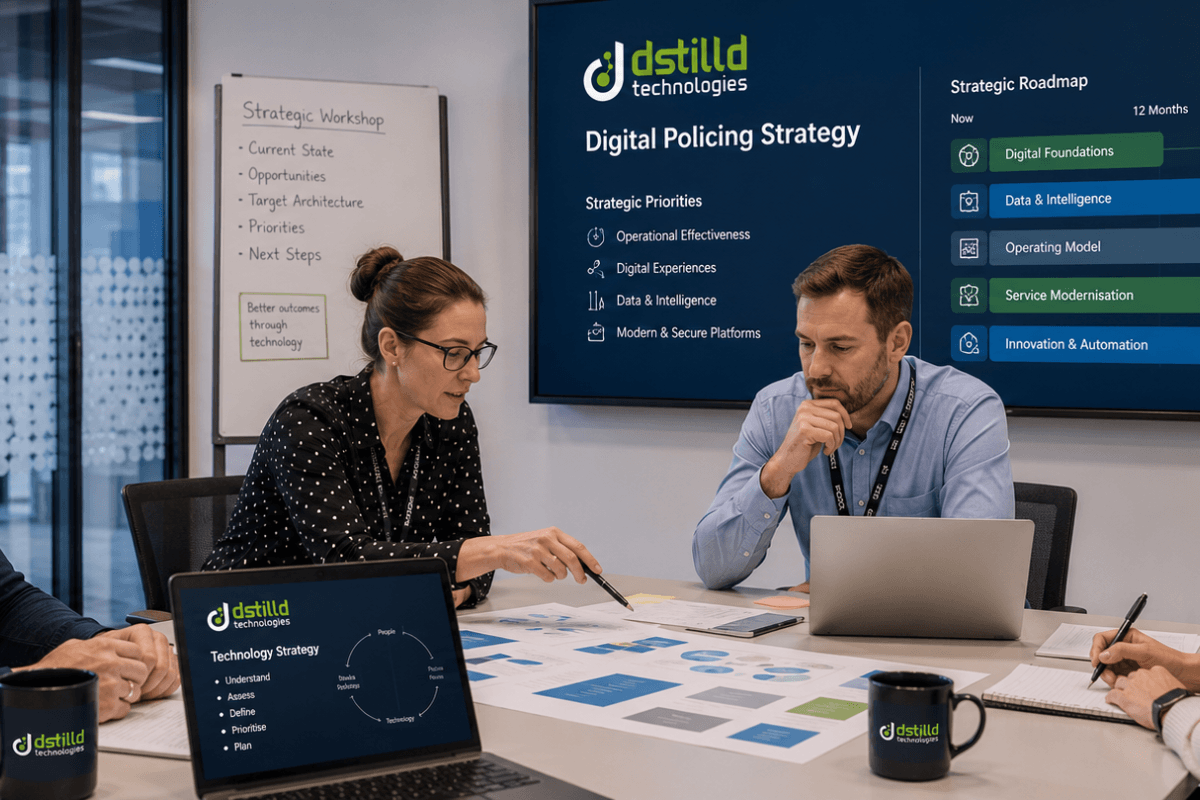
A credible technology strategy for a police force is not a vision document. It is a practical framework that defines where the organisation needs to get to, what it will take to get there, and how technology investment should be sequenced and governed to deliver operational outcomes.
dstilld provides policing technology strategy consulting and advisory to forces and their technology partners, developing strategies that reflect the realities of policing environments – operational constraints, national standards, legacy dependency and the complexity of multi-supplier estates. We bring independent, architecture-led thinking to help organisations define target states, assess their current position and build a transformation direction they can actually execute.
DDaT Strategy for Policing
Our DDaT strategy consulting and advisory sits within the wider Digital, Data and Technology (DDaT) landscape used across UK policing. We help force DDaT leaders connect operational priorities, national direction, architecture, investment and delivery into a coherent and executable technology strategy.
Sector Challenges
- Ageing operational platforms – forces carrying significant legacy debt across command and control, digital investigation, custody and corporate systems, with limited clarity on viable upgrade or replacement pathways.
- Fragmented technology estates – systems acquired incrementally, often through national procurement frameworks, with limited integration and unclear ownership of the overall architecture.
- Rising digital evidence volumes – increasing demand on digital investigation infrastructure outpacing the strategies and platforms designed to support it.
- Funding and investment constraints – capital programmes subject to HMICFRS scrutiny, business case requirements and competing operational priorities, requiring clear prioritisation frameworks.
- Governance complexity – accountability for technology strategy spread across force ICT, operational leads, joint units and national programmes, making strategic alignment difficult to achieve and maintain.
- Interoperability requirements – national policing standards, Home Office connectivity requirements and regional collaboration obligations that shape – and constrain – local technology choices.
- Balancing continuity with modernisation – forces cannot afford operational disruption. Technology strategy must account for what cannot change as much as what needs to.
Typical Consulting & Advisory Areas
- Technology strategy development and documentation
- Target architecture definition
- Transformation roadmap planning and sequencing
- Digital investigations capability strategy
- Command and control platform strategy
- Hybrid cloud and infrastructure strategy
- Data and AI readiness planning
- Supplier and partner landscape alignment
- Operating model and governance design
- Technology investment prioritisation
Example Strategy Activities
Digital investigations roadmap development Working with an investigation capability lead and force ICT to assess the current digital evidence environment, define target capability requirements and produce a sequenced roadmap covering platforms, infrastructure, skills and governance.
Command and control strategy options assessment Evaluating a force’s C&C platform position – current contract status, national programme alignment, strategic options and risk – to support a structured investment and procurement decision.
Hybrid infrastructure strategy Defining a multi-year infrastructure direction for a force transitioning from a predominantly on-premises estate, covering architecture principles, workload classification, security and accreditation requirements and partner model.
AI readiness evaluation Assessing the quality, availability and governance of a force’s operational data against identified AI and analytics use cases, to determine what preparatory work is required before deployment decisions are made.
Technology investment prioritisation Supporting a force technology board in framing a structured approach to capital investment decisions – weighing operational risk, strategic alignment, national direction and value for money across a competing set of programmes.
Multi-year transformation planning Shaping a five-year technology change plan for a force undertaking significant estate modernisation, covering sequencing, dependency management, governance structures and partner engagement strategy.
How We Work
01 – Establish the baseline We begin by understanding the current technology estate, operational dependencies, governance structures and strategic context – including national programme commitments and regional obligations that constrain local decisions.
02 – Define a clear direction We work with senior stakeholders, operational leads and ICT teams to develop a strategy that reflects where the force needs to get to – not where a vendor or framework says it should be.
03 – Build the architecture Strategy without architecture is aspiration. We ground strategic options in target architecture that is realistic, deliverable and consistent with policing security and accreditation requirements.
04 – Sequence and govern We develop roadmaps and governance frameworks that make the strategy executable – with clear ownership, sequenced investment and dependencies mapped across programmes and partners.
We operate independently of vendors and platform providers. Our guidance is shaped by what forces need – not by commercial relationships with what the market is trying to sell.
Related Services & Domains
Services: Technology transformation · Assurance & advisory · Partner services
Operational Domains: Digital investigations & evidence · Command & control platforms · Data & AI foundations · Secure infrastructure & hybrid cloud · Operational technology modernisation